

Mobile game psychology helps explain why certain games are designed to make players return, continue playing, and pursue the next reward.
Mechanics such as variable rewards, login streaks, loss aversion, and limited-time events can create strong incentives to keep playing, even when a player originally planned to stop.
Understanding these systems doesn’t mean that mobile games are inherently manipulative or that enjoying them is a problem.
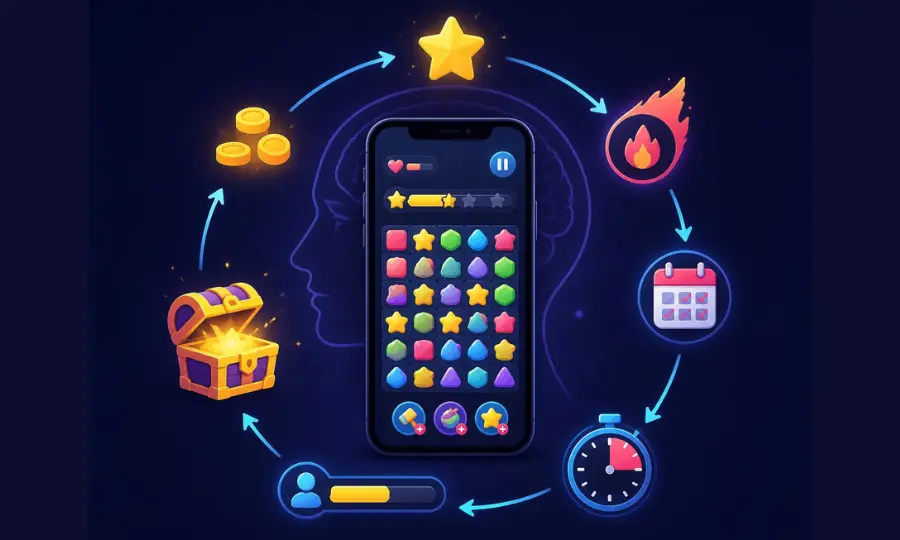
As gaming experts we look at the game-design psychology behind these mechanics, find why they can influence player behavior, how monetization systems such as loot boxes fit into the picture.
And what players can do to recognize these patterns and make more deliberate choices about their gaming time.
Variable Rewards: The Core Psychology Behind Mobile Games
A slot spin, a dice roll, or a loot box all share the same underlying structure: you don’t know exactly what you’ll get, only a range of possibilities.
Psychologically, unpredictable rewards on this kind of schedule tend to sustain engagement more persistently than a reward you can fully predict — the same mechanism behind why a slot machine is more engaging than a vending machine.
Loss Aversion: Why Losing Progress Feels Worse Than Gaining It
Games that track a login streak or a limited resource (like a shield about to expire) tap into loss aversion — the tendency to weigh avoiding a loss more heavily than achieving an equivalent gain.
A streak counter turns “I could log in today” into “I don’t want to lose what I’ve already built,” which is a meaningfully stronger pull.
FOMO and Limited-Time Mobile Game Events
Limited-time events work by making the reward’s availability the scarce resource, not just the reward itself. A booster or card set that’s “only available this week” adds urgency independent of how much you actually want the item — this is the same scarcity principle used broadly in retail marketing, applied to in-game content.
How Regulators Are Responding to Mobile Game Monetization
The legal status of loot-box-style mechanics varies significantly by country. Belgium and the Netherlands have classified certain paid loot boxes as gambling and restricted or banned them outright.
China and South Korea require public disclosure of reward odds.
The United States currently has no federal law specifically regulating loot boxes, though individual states have proposed legislation and the FTC has taken enforcement action in specific deceptive-practice cases.
The European Union has also been moving toward broader digital-fairness rules that could affect loot box access for minors. This is a genuinely unsettled area of law that continues to shift.
How to Play Mobile Games More Mindfully
- Set a session boundary before you open the app, not after — deciding your stopping point in advance is more effective than deciding in the moment.
- Separate “I want to play” from “I don’t want to lose my streak.” If it’s mostly the second one, that’s loss aversion talking, not enjoyment.
- Treat “limited-time” framing with healthy skepticism — ask whether you’d want the reward if it had no deadline attached.
Mobile Game Psychology FAQ
Are loot boxes considered gambling?
It depends on the country. Belgium and the Netherlands classify certain paid loot boxes as gambling; the US currently has no federal classification either way.
Why do login streaks feel so hard to break?
Streaks tap into loss aversion — once you've built one up, stopping feels like losing something you already have, not just skipping a day.
Is it bad to enjoy these game mechanics?
Not inherently — understanding how a mechanic works doesn't mean you can't enjoy it. The goal is playing with awareness, not guilt.
Do all mobile games use these tactics?
Most free-to-play games use at least some of these patterns, since they're standard retention tools across the industry, not unique to any single title.
Disclaimer: This article discusses general game-design psychology and publicly reported regulatory developments. It is not legal, medical, or psychological advice. Loot-box and game-monetization regulations vary by jurisdiction and may change over time. Gamer Orbis is an independent resource and is not affiliated with any game publisher.