

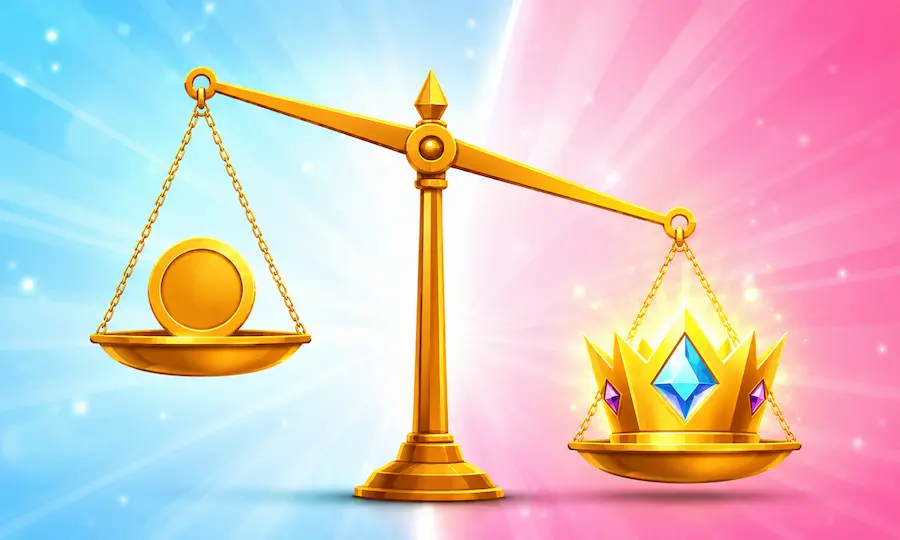
Free to play vs pay to win is not a simple yes-or-no question, especially in mobile games.
A truly free-to-play game lets players access its core mechanics and meaningful progression without paying, while a pay-to-win game gives paying players advantages that free players cannot reasonably obtain through gameplay alone.
Between these extremes is pay-to-speed-up, where spending mainly reduces waiting, resource grinding, or recovery time.
This guide breaks down the three main monetization models, gives you a simple test you can apply to almost any mobile game.
Examines Coin Master, Dice Dreams, and Match Masters to show how the distinction works in practice.
Free to Play vs Pay to Win: The Three Main Categories
| Category | What It Means | Example Pattern |
|---|---|---|
| Free to Play (F2P) | No paywalled content — everything is reachable for free | Every event, mode, and reward tier accessible without spending |
| Pay to Speed Up | Spending buys convenience or speed, not exclusive power | Buying extra spins/rolls that a free player could also earn, just slower |
| Pay to Win (P2W) | Spending unlocks power or content free players cannot reach at all | Exclusive top-tier gear or ranks locked entirely behind purchase |
How to Tell If a Mobile Game Is Pay-to-Win
Can a free player reach every mode and event?
If yes, it’s at least genuinely free to play at the content level.
Can a free player earn the same top-tier rewards, just slower?
If yes, you’re looking at pay to speed up, not pay to win.
Is there a reward, rank, or item only obtainable by paying?
If yes — and it materially affects competitive outcomes — that’s pay to win.
Case Studies: Coin Master, Dice Dreams, Match Masters
All three games covered on this site land in the pay to speed-up category, not pay to win. In each case, spending buys more spins, rolls, or boosters faster — not exclusive villages, kingdoms, or booster tiers unreachable for free.
Why this matters in practice:
A pay to speed up game rewards patience. A genuinely pay to win game doesn’t — no amount of time investment closes the gap against a paying player. Knowing which one you’re in changes whether “grinding it out” is actually a viable free strategy.
Why the Difference Between F2P and P2W Matters
“Free to play” gets used as a marketing label more often than an honest description. A game can be technically free to play while still being pay to win if the free path to top-tier content is so slow it’s functionally unreachable.
The test above cuts through the labeling and gets at what actually determines whether you can compete without spending.
FAQ
Is pay to speed-up the same as pay to win?
No — pay to speed-up means a free player reaches the same content, just slower. Pay to win means some content is unreachable without paying.
Can a game be both free to play and pay to win?
Yes — “free to play” only describes the entry cost, not whether paying gives an unfair competitive advantage later.
Are Coin Master, Dice Dreams, and Match Masters pay to win?
No — all three are pay to speed up. Spending buys faster progress, not exclusive content unreachable for free.
How can I tell before I start playing a new game?
Check whether top-ranked or veteran players in the community are known free players — if so, it’s likely pay to speed up rather than pay to win.
Disclaimer: Classifications reflect general observed patterns across the games discussed and may shift with future updates or monetization changes. This article is independent and not affiliated with any game publisher.